

Cardiac Resynchronisation Therapy (CRT) in London: Specialist Assessment, Implantation and Care

Cardiac Resynchronisation Therapy, Explained by the Specialists
A Treatment That Can Change How You Feel Day to Day

For people whose heart no longer pumps efficiently, the difference cardiac resynchronisation therapy makes can be pivotal – literally giving you your life back.That is why this treatment deserves genuine specialist attention, both in deciding whether it is right for you and in the careful tuning that follows. London Pacemaker Centre is dedicated solely to cardiac devices, so your assessment, your procedure and your long-term follow-up are handled by specialists for whom this is core, everyday work. This page explains the full picture: how we assess suitability for CRT, what implanting a CRT-P or CRT-D device involves, and how revisions work.

Why Choose London Pacemaker Centre

Because we concentrate entirely on cardiac devices, we can offer expertise and continuity that general cardiology rarely matches: fast access to specialist assessment, often within days, the latest device technology, and a dedicated long-term follow-up and optimisation service. CRT in particular rewards careful follow-up, because getting the settings right over time is part of what makes patients feel better. We see both self-funded and insured patients, in modern facilities on Wimpole Street in London’s Harley Street medical district and at the internationally recognised Harefield Hospital in North West London.

We also believe these decisions are conversations, not instructions. We explain things clearly, answer honestly, and make recommendations rather than decisions, so the path you take is the right one for you.

Being told you may need a defibrillator can be frightening. Our role is to explain clearly why it is recommended, what living with one is really like, and to answer every question honestly, so the decision you reach is genuinely the right one for you.

What Is Cardiac Resynchronisation Therapy

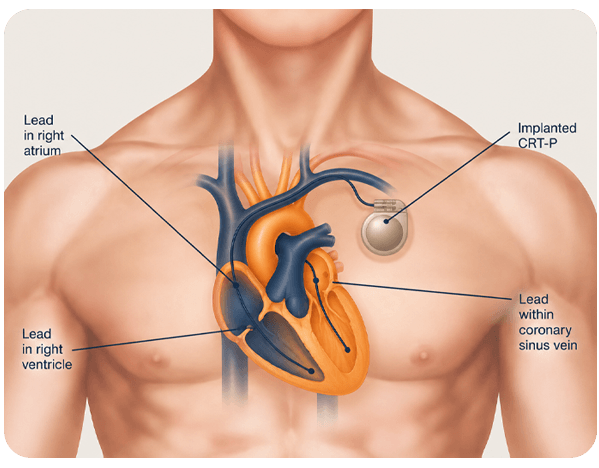
Cardiac resynchronisation therapy treats hearts that work inefficiently, usually because the heart’s pumping function is already weakened and the chambers are no longer contracting in a coordinated way. By pacing both sides of the heart, a CRT device helps the chambers beat back in synchrony, which can improve how effectively the heart pumps. For suitable patients, this can ease symptoms and improve quality of life.

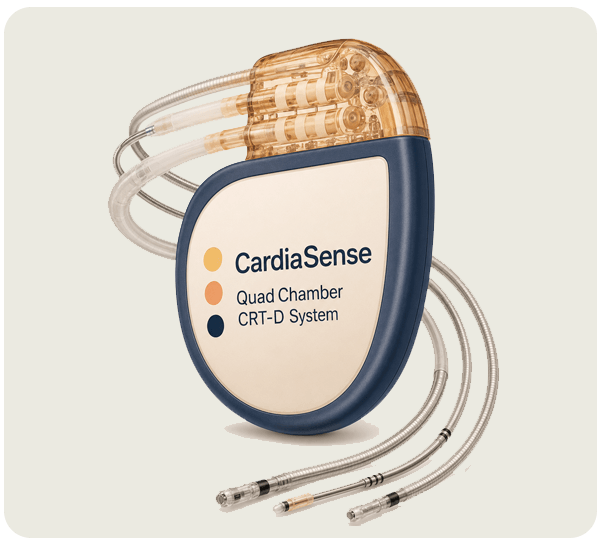
A CRT device is sometimes called a biventricular device, because it usually involves an additional lead so that both lower chambers of the heart can be paced together. There are two types:
The main types

Transvenous ICD

Leads pass through a vein into the heart; can be single- or dual-chamber and also provide pacing.

Subcutaneous (S-ICD)

Sits entirely under the skin with no leads inside the heart or veins, suitable for many patients.

CRT-D

Combines defibrillator protection with resynchronisation therapy for suitable patients with heart failure.

CRT Assessment

CRT is recommended only after careful assessment, because it is suited to a specific group of patients, generally those with reduced heart function and signs that the heart’s chambers are contracting out of step with one another.

Assessment brings together your clinical history, an ECG to look at the heart’s electrical timing, cardiac imaging such as an echocardiogram to assess function, and a frank discussion of your symptoms and how they affect your daily life. A central question is whether you would benefit from resynchronisation alone, a CRT-P device, or whether you also need the protection of a defibrillator, a CRT-D device. We take the time to work through this with you, because the right answer depends on your individual heart condition and your priorities.

CRT-P and CRT-D Implantation

Implanting a CRT device is similar in principle to a pacemaker or defibrillator, but is a more involved procedure because it usually requires an additional lead to pace the heart’s chambers in synchrony.

The procedure is carried out under local anaesthetic with sedation, so you are comfortable throughout. Leads are guided through a vein into the heart and the device is placed under the skin near the collarbone, much as with other devices. Because CRT requires careful positioning of an additional lead, it can take longer than a standard implant. Most procedures take around an hour, and a complex resynchronisation procedure can sometimes take up to a couple of hours. You should not feel pain, only some pressure or movement, with pain relief available throughout.

For a standard CRT implant, no. It is a form of minor surgery with a low risk of serious complications and a very low risk to life, although it is a more intricate procedure than a simple pacemaker. As with any device, uncommon complications can include bleeding or bruising, lead displacement, infection at the site, and rarely a lung complication, and your team monitors closely to catch any issue early.

Recovery is broadly similar to other devices. Most people go home the same day or the next, the site usually heals within a couple of weeks to a month, and you will be asked to limit movement of the arm on the implant side and avoid lifting above shoulder height for around four to six weeks, while not keeping it completely still. With CRT, an important point is that the benefit is not always immediate. For some patients it takes time, and careful follow-up and adjustment, before the full improvement in symptoms and quality of life is felt. This is exactly the kind of ongoing, attentive care a dedicated centre is built to provide.

CRT Revision

Like all implantable devices, a CRT device does not last indefinitely, and occasionally the system needs attention rather than just routine monitoring.

A CRT device contains a sealed battery that gradually depletes over a number of years. When it approaches the end of its life, the generator is replaced in a procedure, with the existing leads usually left in place if they are working well. Battery status is checked at every routine review, so a replacement can be planned comfortably in advance.

Revision also covers upgrades and lead-related procedures. Some patients come to CRT as an upgrade, when a conventional pacemaker is no longer meeting their needs and resynchronisation is added to restore quality of life. Others may need a CRT-P device upgraded to a CRT-D, or a lead revised if it is not performing as it should. The additional left-sided lead used in CRT can occasionally need attention. Where a lead needs to be removed entirely, this is a specialist procedure in its own right, carried out by clinicians with specific expertise in lead extraction, and we will explain it fully if it ever becomes relevant to you.

For wider guidance, see our pages on pacemakers, including conduction system pacing, an emerging technique that may in time offer an alternative to resynchronisation therapy for some patients, as well as the cost of private cardiac device care, ongoing device checks and optimisation, and living with a cardiac device.

Conduction System Pacing

Conduction system pacing is one of the most significant recent developments in this field, and it is an area in which a specialist centre comes into its own.

Your heart has its own electrical network, the cardiac conduction system, which controls how each heartbeat spreads. Traditional pacemakers usually stimulate the right ventricle, which works well and is proven over many years, but can create a slightly less natural pattern of contraction. Conduction system pacing instead stimulates the heart’s natural wiring directly, producing a more natural activation pattern.

For some patients, this more natural pacing can improve the efficiency of the heart compared with standard pacing, and it may reduce certain long-term complications associated with conventional pacing. It is increasingly regarded as the gold-standard approach for some patients who need a pacemaker, and over time it may come to replace cardiac resynchronisation therapy in selected cases. It is, however, more technically challenging to implant, is not suitable for every patient, and requires a clinician specifically trained in the technique, which is precisely the kind of expertise concentrated in a dedicated device centre. Your consultant will discuss the merits for your individual situation.

What Our Patients Say

Frequently Asked Questions

Cardiac Resynchronisation Therapy and Who It Helps

CRT is a treatment for hearts that pump inefficiently, usually because function is already weakened and the chambers are contracting out of step. By pacing both sides of the heart, it helps them beat in synchrony, which can improve the heart’s efficiency and, for suitable patients, ease symptoms and improve quality of life.

CRT-P provides resynchronisation pacing. CRT-D provides the same resynchronisation pacing and also includes the protective function of a defibrillator, for patients who are additionally at risk of dangerous fast heart rhythms.

It is closely related. A CRT device, sometimes called a biventricular device, uses pacing to coordinate the heart’s chambers. A CRT-D also adds defibrillator protection.

CRT Assessment

Through assessment that combines your clinical history, an ECG to assess the heart’s electrical timing, cardiac imaging to assess function, and a discussion of your symptoms. We also determine whether you would benefit from a CRT-P or a CRT-D device.

CRT is generally suited to patients with reduced heart function and evidence that the heart’s chambers are contracting out of synchrony. Specialist assessment confirms whether it is right for you.

CRT-P and CRT-D Implantation

Most procedures take around an hour, and a more complex resynchronisation procedure can sometimes take up to a couple of hours, because it usually involves positioning an additional lead.

You should not feel pain during the procedure. It is carried out under local anaesthetic with sedation, and any soreness afterwards usually settles within about a month.

For a standard implant, no. It is a form of minor surgery with very low risk, though it is more intricate than a simple pacemaker.

Recovery and Benefits

Not always immediately. For some patients the improvement in symptoms and quality of life takes time, and careful follow-up and adjustment, which is why ongoing specialist care matters.

Most people go home the same day or the next, with the site healing within a couple of weeks to a month. Limit heavy lifting and overhead arm movement on the implant side for around four to six weeks.

CRT Revision

Battery life varies by device and how often it is needed. It is monitored at every routine check, so a replacement can be planned well in advance.

Yes. Some patients come to CRT as an upgrade, when a conventional pacemaker is no longer meeting their needs and resynchronisation is added to help restore quality of life. A CRT-P device can also be upgraded to a CRT-D where appropriate.

Book an Appointment

Whether you are being assessed for cardiac resynchronisation therapy, considering a CRT-P or CRT-D device, or due a generator change or upgrade, London Pacemaker Centre offers expert, specialist care from first assessment through to long-term follow-up. Contact us to arrange a consultation or make a referral, and our team will ensure you receive prompt, expert and personalised care.