

Pacemakers in London: Specialist Assessment, Implantation and Care
One Clinic, Focused Entirely on Devices Like Yours
Why Choose London Pacemaker Centre
Because we concentrate on one field, we can offer a level of expertise and continuity that general cardiology services rarely match. That means fast access to specialist assessment, often within days, the latest device technology including leadless and conduction system pacing, MRI-compatible devices, and a dedicated long-term follow-up and optimisation service so the care does not stop the moment the device is in. We see both self-funded and insured patients, in modern facilities on Wimpole Street in London’s Harley Street medical district and at the internationally recognised Harefield Hospital in North West London.
Above all, we believe good cardiac care begins and ends with communication. We explain things clearly, answer honestly, and make recommendations rather than decisions, so the path you take is genuinely the right one for you.
What a Pacemaker Is
A pacemaker is a small device that helps control the heart’s rhythm, most often when the heart beats too slowly. It sends tiny electrical impulses to keep the heart beating at a normal rate. In most patients it is programmed to step in only when needed, and simply to monitor the rest of the time, which also helps preserve battery life. A pacemaker may be recommended for a slow heart rate (bradycardia), fainting caused by irregular rhythms, certain types of heart block, and some cases of heart failure.
There are several types. A single-chamber pacemaker stimulates one chamber of the heart, a dual-chamber device coordinates the upper and lower chambers, and a biventricular device, used in cardiac resynchronisation therapy, helps both sides of the heart beat in synchrony. Newer approaches, leadless pacemakers and conduction system pacing, are explained in detail below.
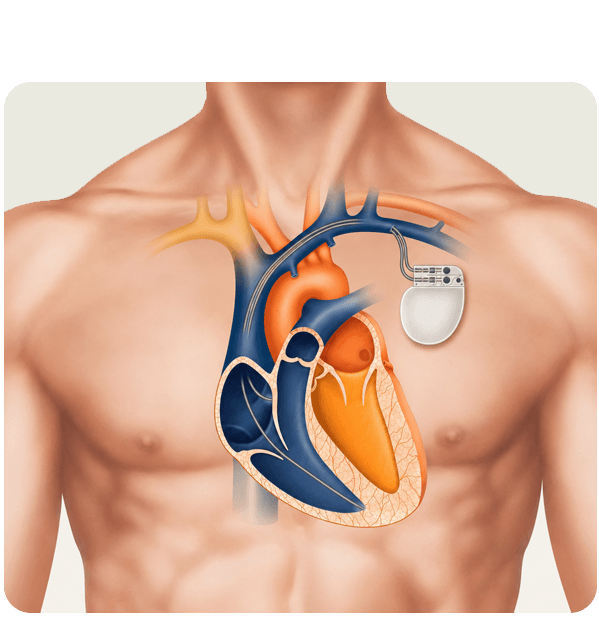
The main types
Pacemaker Assessment
Before any treatment, the priority is an accurate diagnosis. The aim of assessment is to capture what your heart is doing at the moment you feel unwell, and to confirm whether a pacemaker is genuinely the right answer.
Assessment usually begins with the basics: a careful history and an ECG, the simple heart tracing that remains one of the most valuable tests we have. From there we build as needed. We may record your heart rhythm continuously over a period, draw on data from your own wearable such as a smartwatch, recommend a simple handheld recorder you can use the instant symptoms strike, or, for infrequent symptoms, fit a small implantable loop recorder that monitors your rhythm for up to three years and alerts us automatically to any event.
Honest assessment also means recognising when a pacemaker is not the answer. Some blackouts are caused by a drop in blood pressure rather than a slow heart rhythm, a pattern known as vasovagal syncope, which is treated differently. Some patients have a fast rhythm rather than a slow one, which follows another pathway altogether. Identifying the true cause spares you an unnecessary procedure and points you toward the right care.
Frequently Asked Questions
Pacemaker Assessment
Pacemaker Implantation
Generator Change and Revision
Leadless Pacemakers
Conduction System Pacing
Book an Appointment
Whether you are being assessed for a pacemaker, due a generator change, or interested in newer options such as leadless or conduction system pacing, London Pacemaker Centre offers expert, specialist care from first assessment through to long-term follow-up. Contact us to arrange a consultation or make a referral, and our team will ensure you receive prompt, expert and personalised care.